Explore Resources
Browse our curated collection of educational tools, simulations, and teaching aids.
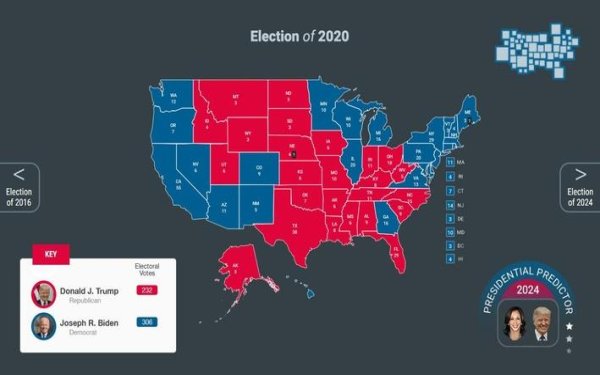
Electoral Decoder | Interactive Map
Use this interactive map to explore the past 59 presidential elections (1789–2020). Learn about the significance of the Electoral College by comparing the map and the electoral cartogram. Delve further into history by reading a brief overview of the Electoral College and the role of electors and looking at key events in past elections. Then, use the "Presidential Predictor" to see how a candidate might win the electoral vote in the next election. How would you strategize a political campaign to win the presidency?

YouthQuake: Investigating Earthquakes with Code
Through block coding with the GeoCoder, students will investigate how land movement causes earthquakes and how deformation build-up poses risks to people and their communities.

Battery-Resistor Circuit Simulation
This interactive PhET simulation allows students to build and explore simple battery-resistor circuits virtually. Learners can manipulate battery voltage and resistor values, observing in real-time how these changes affect current and voltage across components. It provides a dynamic environment for understanding Ohm's Law and fundamental circuit principles without the need for physical equipment. Teachers can use this tool to facilitate inquiry-based investigations, reinforce theoretical concepts, and support visual learners in grasping abstract electrical phenomena.

Balloons and Static Electricity
This PhET simulation allows students to explore the fundamental principles of static electricity through interactive manipulation of balloons and various objects. Users can observe charge transfer, attractive and repulsive forces, and the behavior of charged particles when interacting with neutral and charged surfaces. It provides an excellent virtual laboratory for understanding concepts like conductors, insulators, and the fundamental nature of electric charge. Teachers can utilize this tool to facilitate inquiry-based learning and visualize abstract physics phenomena in an engaging way.
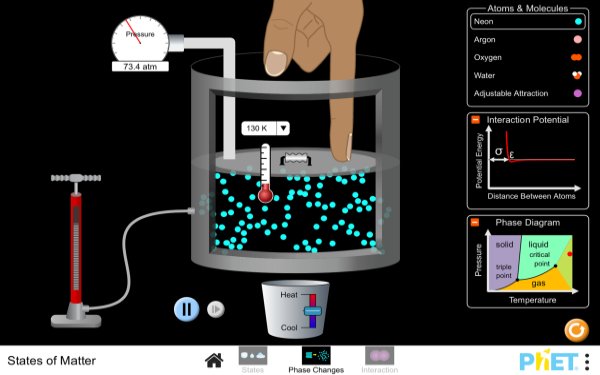
Atomic Interactions
This interactive PhET simulation allows students to explore the fundamental concepts of states of matter (solid, liquid, gas) by manipulating temperature and observing molecular motion and interactions. Teachers can use this engaging tool to facilitate inquiry-based learning, enabling students to visualize phase changes and understand the kinetic molecular theory. It supports conceptual understanding in chemistry and can be integrated into lessons on physical properties and energy. The simulation provides a dynamic, hands-on virtual environment for students to conduct experiments and draw conclusions about the behavior of matter.

Assessing Volcanic Hazards and Risk with Code
This interactive e-resource from the Concord Consortium offers students a dynamic platform to explore scientific concepts through engaging models and simulations. Designed to foster deep understanding, it allows learners to manipulate variables, observe real-time outcomes, and conduct virtual experiments. The resource promotes critical thinking and inquiry-based learning, encouraging students to analyze data and draw conclusions from their investigations. It provides a hands-on approach to science education, making abstract ideas concrete and accessible.

Code.org (Hour of Code)
The Hour of Code, powered by Code.org, is a global movement designed to introduce K-12 students to the fundamentals of computer science through engaging, one-hour tutorials. It offers a wide array of activities from various partners, making coding accessible and fun for all ages and skill levels, even for those with no prior experience. Teachers can easily integrate these free, interactive lessons into their curriculum to foster computational thinking and digital literacy. This initiative serves as an excellent entry point for students to explore coding and develop critical problem-solving skills.

Air Pollution 1a
This interactive simulation from Concord Consortium allows students to explore the causes and effects of air pollution in a controlled environment. Teachers can utilize this digital tool to facilitate inquiry-based learning, enabling students to manipulate variables such as emission sources and atmospheric conditions to observe their impact on air quality. It provides a visual and engaging way to understand complex environmental science concepts, fostering critical thinking and data analysis skills. Ideal for middle and high school science curricula, this resource supports discussions on environmental responsibility and scientific investigation.

Air Pollution 1
This interactive simulation from The Concord Consortium allows students to explore the fundamental concepts of air pollution. Educators can use this resource to engage learners in understanding the sources, transport, and impact of various pollutants on environmental and human health. It provides a dynamic platform for students to conduct virtual experiments, observe cause-and-effect relationships, and develop a deeper scientific understanding of critical environmental issues. This tool is ideal for fostering inquiry-based learning in environmental science, chemistry, and general science curricula.
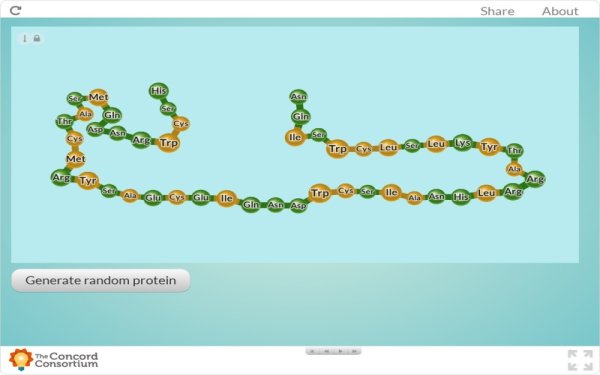
DNA to Protein Variations: Random Protein Synthesis Interactive
This interactive simulation from The Concord Consortium allows students to explore the fundamental processes of DNA transcription and translation, focusing on how random variations in DNA sequences can lead to different protein structures. Students can manipulate genetic code and observe the resulting changes in protein synthesis, fostering a deeper understanding of genotype-phenotype relationships. This tool is ideal for demonstrating key concepts in molecular genetics and can be used to facilitate inquiry-based learning about mutations and genetic diversity. Teachers can integrate this resource to support lessons on protein synthesis, genetic code, and the impact of DNA variations.
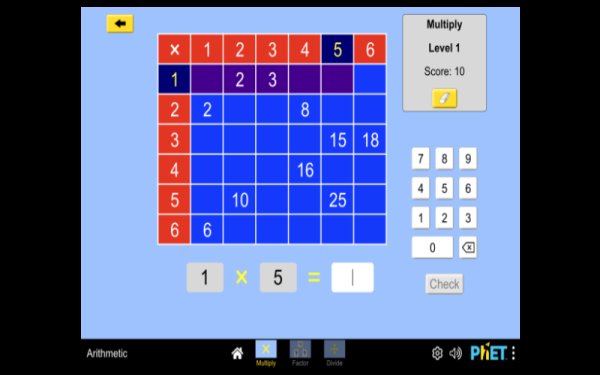
Arithmetic - Multiplication | Division | Factoring - PhET Interactive Simulations
This PhET Interactive Simulation offers an engaging platform for students to explore fundamental arithmetic concepts, including multiplication, division, and factoring. Through interactive visual models like number lines and arrays, learners can develop a deeper understanding of operations with both positive and negative integers, as well as prime factorization. It provides a hands-on, exploratory environment that supports conceptual understanding and fact fluency in a dynamic way. Teachers can leverage this free resource to facilitate interactive math lessons and support differentiated instruction in their classrooms.

Acid-Base Solutions
How do strong and weak acids differ? Use lab tools on your computer to find out! Dip the paper or the probe into solution to measure the pH, or put in the electrodes to measure the conductivity. Then see how concentration and strength affect pH. Can a weak acid solution have the same pH as a strong acid solution?