Explore Resources
Browse our curated collection of educational tools, simulations, and teaching aids.

Battery-Resistor Circuit Simulation
This interactive PhET simulation allows students to build and explore simple battery-resistor circuits virtually. Learners can manipulate battery voltage and resistor values, observing in real-time how these changes affect current and voltage across components. It provides a dynamic environment for understanding Ohm's Law and fundamental circuit principles without the need for physical equipment. Teachers can use this tool to facilitate inquiry-based investigations, reinforce theoretical concepts, and support visual learners in grasping abstract electrical phenomena.

Balloons and Static Electricity
This PhET simulation allows students to explore the fundamental principles of static electricity through interactive manipulation of balloons and various objects. Users can observe charge transfer, attractive and repulsive forces, and the behavior of charged particles when interacting with neutral and charged surfaces. It provides an excellent virtual laboratory for understanding concepts like conductors, insulators, and the fundamental nature of electric charge. Teachers can utilize this tool to facilitate inquiry-based learning and visualize abstract physics phenomena in an engaging way.

Beer's Law Lab
This PhET simulation provides an interactive virtual laboratory for exploring Beer's Law and spectrophotometry. Students can manipulate variables such as solution concentration, path length, and wavelength to observe their effects on light absorbance. It allows for hands-on experimentation without physical lab equipment, fostering a deeper understanding of the quantitative relationship between concentration and absorbance. This resource is ideal for reinforcing concepts, preparing for wet labs, or serving as a standalone inquiry-based activity in high school or introductory college chemistry courses.
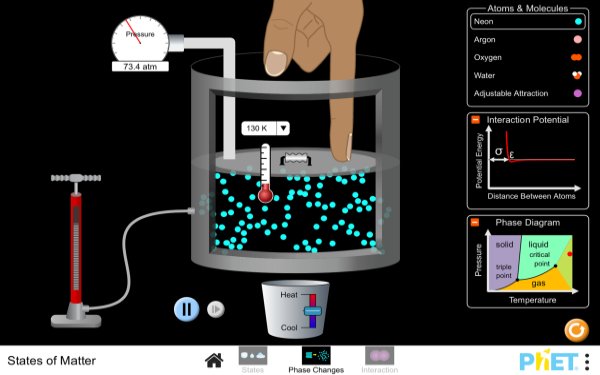
Atomic Interactions
This interactive PhET simulation allows students to explore the fundamental concepts of states of matter (solid, liquid, gas) by manipulating temperature and observing molecular motion and interactions. Teachers can use this engaging tool to facilitate inquiry-based learning, enabling students to visualize phase changes and understand the kinetic molecular theory. It supports conceptual understanding in chemistry and can be integrated into lessons on physical properties and energy. The simulation provides a dynamic, hands-on virtual environment for students to conduct experiments and draw conclusions about the behavior of matter.

Assessing Volcanic Hazards and Risk with Code
This interactive e-resource from the Concord Consortium offers students a dynamic platform to explore scientific concepts through engaging models and simulations. Designed to foster deep understanding, it allows learners to manipulate variables, observe real-time outcomes, and conduct virtual experiments. The resource promotes critical thinking and inquiry-based learning, encouraging students to analyze data and draw conclusions from their investigations. It provides a hands-on approach to science education, making abstract ideas concrete and accessible.

Air Pollution 1a
This interactive simulation from Concord Consortium allows students to explore the causes and effects of air pollution in a controlled environment. Teachers can utilize this digital tool to facilitate inquiry-based learning, enabling students to manipulate variables such as emission sources and atmospheric conditions to observe their impact on air quality. It provides a visual and engaging way to understand complex environmental science concepts, fostering critical thinking and data analysis skills. Ideal for middle and high school science curricula, this resource supports discussions on environmental responsibility and scientific investigation.

Acid-Base Solutions
How do strong and weak acids differ? Use lab tools on your computer to find out! Dip the paper or the probe into solution to measure the pH, or put in the electrodes to measure the conductivity. Then see how concentration and strength affect pH. Can a weak acid solution have the same pH as a strong acid solution?

Learn With Us | National Geographic Society
Learn With Us from the National Geographic Society offers a rich collection of educational opportunities designed to ignite curiosity and foster a deep understanding of our planet and its diverse inhabitants. This resource provides educators with engaging content spanning geography, history, and culture, empowering learners to explore global topics through authentic narratives and compelling visuals. Materials promote inquiry-based learning, leveraging stunning photography and firsthand accounts that serve as invaluable primary sources. It's an excellent hub for K-12 teachers seeking resources to bring the wonder of the world into their classrooms.

History Matters
"History Matters: The U.S. Survey Course on the Web" is an extensive online resource crafted to support educators in teaching U.S. history from K-12 through college levels. It provides a rich array of teaching materials, including lesson plans and primary sources, to facilitate engaging and inquiry-based learning experiences. This platform encourages students to develop critical thinking skills and historical literacy through its accessible digital content. It serves as a valuable tool for exploring diverse historical perspectives and building comprehensive U.S. history curricula.

Perplexity
Perplexity is a free, AI-powered answer engine that provides accurate, trusted, and real-time information to a wide range of questions, citing its sources. Educators can leverage Perplexity to support student research, foster inquiry-based learning, and quickly fact-check information across various subjects. Its ability to summarize complex topics and provide contextual understanding makes it a valuable tool for developing information literacy in the digital age. This resource helps students find reliable answers and explore topics deeply, enhancing their learning experience.
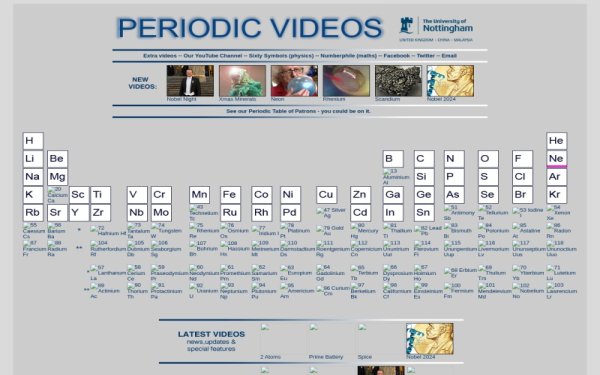
The Periodic Table of Videos - University of Nottingham
The Periodic Table of Videos offers an extensive collection of short, engaging videos covering every element on the periodic table. Developed by the University of Nottingham, this resource also includes a variety of other cool chemistry experiments and related scientific content. It serves as an excellent supplementary tool for chemistry teachers and students, promoting visual learning and sparking curiosity through dynamic demonstrations. Educators can use these videos to introduce topics, reinforce concepts, or inspire inquiry-based projects in the classroom.

Stanford History Education Group (SHEG) - History Lessons
The Stanford History Education Group (SHEG) offers a robust collection of free, research-based history lessons designed to cultivate historical thinking and critical analysis skills in students. Each lesson, part of their "Reading Like a Historian" curriculum, provides primary source documents and detailed teaching materials to engage students in meaningful historical inquiry. Educators can access ready-to-use lesson plans that emphasize document analysis, evidence-based reasoning, and understanding multiple perspectives, empowering students to evaluate historical sources critically and construct evidence-backed arguments. This invaluable resource supports teachers in shifting classrooms from passive reception to active investigation, enhancing students' ability to interpret historical events and sources.